Step 12: Calculate Training’s ROI
In the previous step we calculated that the annual impact from business acumen training was $312,275. Is $312,275 attractive to key decision makers? How much will it cost to produce this impact? What is the return for this investment? Should we invest our scarce resources on training, or would the funds be better spent somewhere else?
These are all good questions that can be answered by calculating training’s Return on Investment (ROI). ROI is a measure of the productivity of a firm’s assets (in this case, money) and is a performance measure used to evaluate the efficiency of an investment or to compare the efficiency of a number of different investments. To calculate ROI, the benefit (return) of an investment is divided by the cost of the investment; the result is expressed as a percentage or a ratio. For training’s ROI, the predicted impact (benefit) is divided by the cost of the training. The training return on investment formula is as follows:
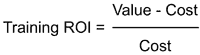
Return on investment is a popular metric because of its versatility and simplicity. As with any investment analysis, training if does not have a positive ROI or if there are other opportunities with a higher ROI, training should not be undertaken.
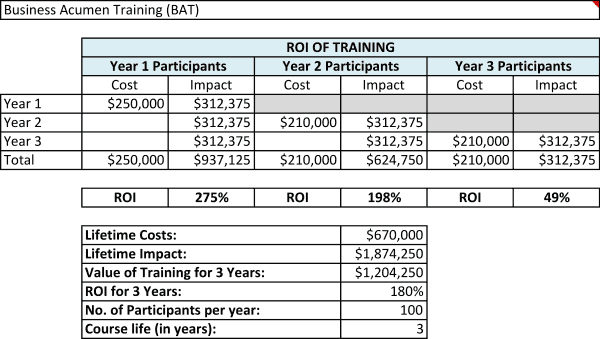
Business Acumen Training has a projected lifespan of three years, with 100 employees being trained annually. Looking at the year 1 cohort (the group of employees trained in that year), it cost $250,000 in year one to train them (design + development + delivery + evaluation). The annual predicted impact is $312,375 which sums to three years of cumulative impact of $937,125. Employees trained in year 1 have no costs or impact but they do have cost in year 2 ($210,00) and two years worth of impact ($624,750). Employees trained in year 3 have no costs or impact in years 1 or 2, but they do have cost in year 3 ($210,00) and one year of impact ($312,375).
Each year as an ROI calculated. Completing the ROI analysis for three years, BAT will cost $670,000 to train 300 employees. The predicted impact from the 300 employees in the three-year lifespan of the course is $1,874,250, giving us a value of trading of $1,204,250. Resulting in a three-year ROI of 180 percent.
Companies usually have defined hurdles (minimum ROI) that investments need to achieve before key decision-makers approve the investment. Check with your finance department and use whatever values have been set.
Summary
That concludes the series on how to predict training value. More information can be found at my website or purchase my Predicted Evaluation book .