


Category: Training
So honored that training magazine just published my article on Getting Managers Engaged in Employee Training . This is one element of my Learning to Performance (L2P) approach. L2P is a complete training approach that combines learning, leadership and change management competencies to produce documented, sustainable results and value.
I hope you enjoy the article and I would love to hear what you have done in this area.
Last week I spoke at and attended the Training 2013 Conference in Orlando, FL. These are always wonderful times for me because for 3 solid days I just think about the training business which is my passion. I look for ways to be better. I and think of how the training function could be better. I observe and spend time thinking about how I can contribute to this wonderful profession that I am blessed to part of. Late one afternoon I wrote in my notes: “So many times we make decisions about training based too much on emotions”.
Think of a time where you were preparing a training plan for a senior executive., where due to your needs analysis you had bulletproof facts, reason, and logic on your side, and believed there was absolutely no way the executive could say no to your perfectly constructed training proposal. To do so would be impossible, you figured, because there was no other logical solution or answer.
 The executive listened politely and then alternatively told you exactly what to train and how. She dug in her heels on denying your proposal and refused to budge. She wasn’t swayed by your logic or needs analysis. Were you flabbergasted? I am embarrassed to say that this has happened to me way too many times. Because my approach to this is usually as a set of facts, I are was doomed to fail because decision-making isn’t just logical – according to the latest findings in neuroscience, it’s
EMOTIONAL
. So at the point of decision, remember that emotions are very important for choosing. In fact, even with what we believe are logical decisions, the very point of choice is arguably always based on emotion.
The executive listened politely and then alternatively told you exactly what to train and how. She dug in her heels on denying your proposal and refused to budge. She wasn’t swayed by your logic or needs analysis. Were you flabbergasted? I am embarrassed to say that this has happened to me way too many times. Because my approach to this is usually as a set of facts, I are was doomed to fail because decision-making isn’t just logical – according to the latest findings in neuroscience, it’s
EMOTIONAL
. So at the point of decision, remember that emotions are very important for choosing. In fact, even with what we believe are logical decisions, the very point of choice is arguably always based on emotion.
This finding has enormous implications for training professionals. Bringing emotions into business decisions used to be considered taboo, but times have changed dramatically. People who believe they can build a case for their training program using only reason and numbers are in trouble because they don’t understand the real factors that are driving the other party to come to a final decision. Those who base their training strategy on logic end up relying on assumptions, guesses, and opinions. I’ve always thought that if my analysis is logical, then leaders can’t argue with it and are bound to come around to my way of thinking. The problem is, you can’t assume that the other party will see things your way.
I’m a business guy in a trainer’s body. I love metrics – my books tell that story. Forecast, measure, and improve. Period. For me numbers and charts are the core to understanding the success of training. Until now. While I still believe that metrics are essential, I have now added emotional decision- making to my proposals.
Imagine if. A good friend, Elizabeth Doty, and I are members of the the Berrett-Koehler Authors Cooperative board of directors. Recently, Elizabeth and a group of authors were attempting to get a new program started with the Co-op but the leadership team was not listening. Then on for a board conference call, she put together a scenario which she titled, “Imagine If”. She took walked the leadership team through a scenario that showed the future and the benefits of program – the beauty in the this approach was that she touched on their emotions while incorporating costs and return on investments. It worked! They listened and unanimously approved the program.
I now use this approach with all my proposals and I find that I am closing more deals and getting stronger buy-in than ever before. Try it and see how it works for you.
Thank you for reading and as always, I invite your comments and thoughts.
Over the past few years I have been pondering the question “Is training an outcome driven business or an activity driven function?” Think about it. Too many times we design training that links content to intended business results, deliver the course resulting in participant skill/knowledge change, but then just report the activity.
What I continually see in my experience are activity measures being reported by training functions versus the key impact to business results. For example, those being:
- Number of employees trained
- Hours trained
- Cost to train versus budget
- Level 1 end-of-course reaction results (one could argue that these data begin to report outcomes – those being participants’ reaction or satisfaction with the training experience)
I believe that these metrics are necessary and essential but they are activity metrics not outcome measures which are even more essential. Outcome measures should state the value that training has brought to the business . In other words: impact. So what are some outcome driven business metrics? There are many and they need to be chosen so that it is within the context of your company and its typical reporting measures. Here is the approach I use:

If you think of a training program as having a product life cycle (the stages through which a course bypasses) consider using 5 stages: 1) Forecast, 2) Design & Development, 3) Delivery, 4) Transfer, and 5) Impact.
Forecast. This helps management in its attempts to cope with the uncertainty of the future, relying mainly on data from the past and present and analysis of trends. Forecasting starts with certain assumptions based on the management’s experience, knowledge, and judgment. Elements I use in a training forecast are:
- Budget for all stages
- Design & development cycle time
- Number of employees trained
- Predictive Evaluation Impact Matrix ( Intention , Adoption , Impact )
- Predictive Evaluation ROI
Forecasting usually is coupled with a needs analysis in which the learning objectives are provided.
Delivery. The activity metrics used in delivery are typically:
- Expense versus budget
- Number of employees trained
- Training hours delivered
During delivery, outcome measures can be used. The measures I use are:
- End of course reaction
- Predictive Evaluation Intention Score
- Predictive Evaluation Belief Score
Transfer. The transfer outcome measure is the rate and degree that participants have applied training skills on the job. The transfer outcome measure I use is the Predictive Evaluation Adoption Rate.
Impact. Successful transfer should lead to increased employee and organizational performance which results in Impact – tangible business results from training. The impact outcome measure I use is the Predictive Evaluation ROI.
Thank you for reading and as always, I invite your comments and thoughts.
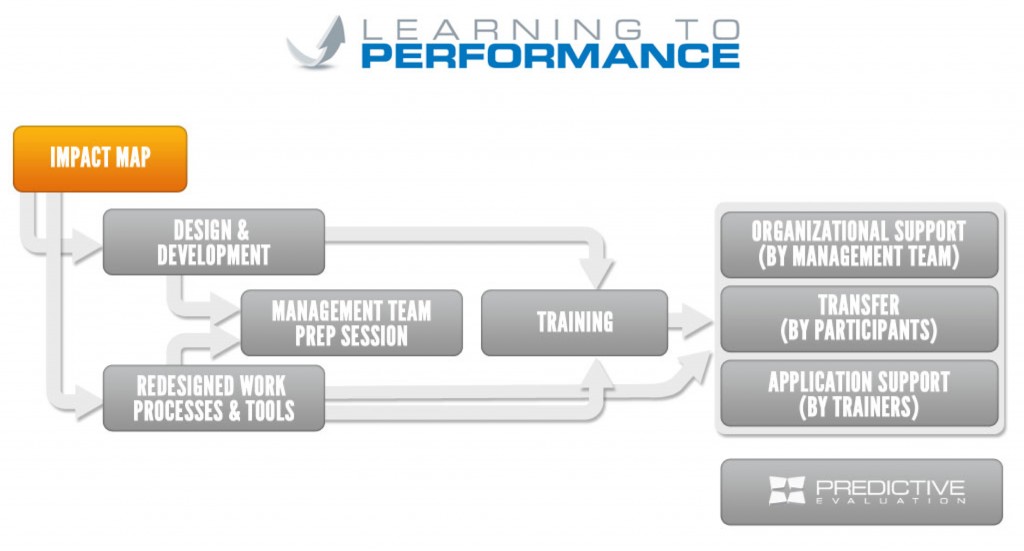
The first step in my
Learning to Performance system
is to create an Impact Map for the proposed
training
course or curriculum. Today’s competitive advantage goes to those who can learn and adapt faster. High Impact Learning integrates learning, leadership and change management competencies to produce documented, sustainable results and ensures courses are linked to business
results
. The Impact Map is a proven method for rapidly
identifying training needs
, evaluating options, and quickly prototyping innovative solutions. Its power lies in providing a clear line of sight linking the content of the training through to the outcomes desired by management. It is therefore indispensable to the instructional designer as well as those tasked with delivering the training.
ASTD Learning and Development Blog - April 16, 2012 – “Learning Bursts and Business Acumen Training: A Case Study”. Ran my article on how Powers Resourse Center successfully used the Learning Burst training methodology with one of their clients. Click here to read the article.
Many thanks to Dr. Phil Young and Tara Powers for their inventive approach to using Learning Bursts.

If you would like to learning more about the Learning Burst training method, you can watch my webinar on demand Introducing Learning Bursts: A Different Way to Deliver Training .