Learning to Performance
Often, companies diagnose a performance gap, requiring training as the solution. Isolated training events that don’t take a “complete training approach” produce less results (value to the business) than a more comprehensive, integrated approach. Complete training combines learning, leadership and change management competencies to produce documented, sustainable results and value. With all my custom training solutions , I use this approach, which I call the Learning to Performance System :
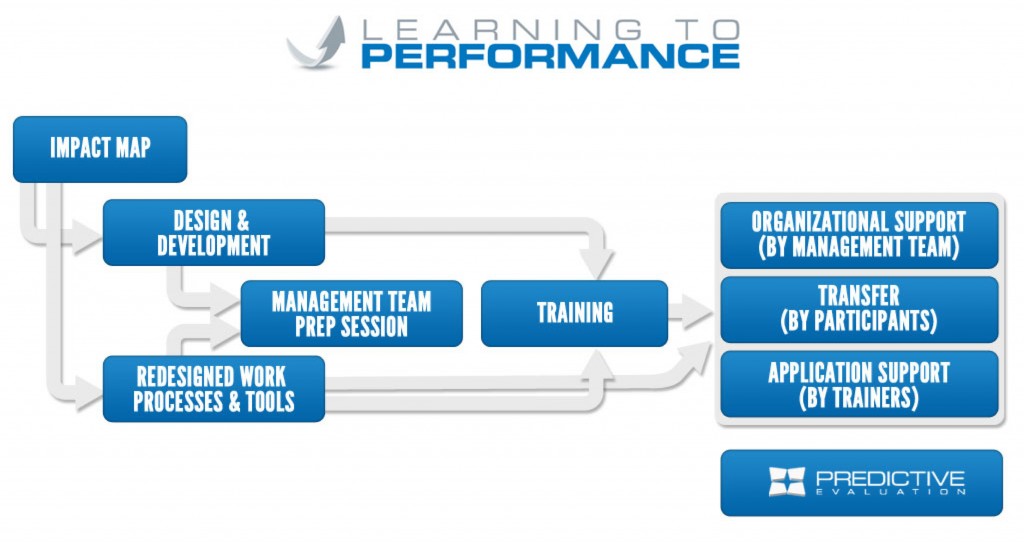
The system begins when leadership recognizes a problem and an obstacle to solving the problem is a lack of skills (training). Step 1 is to create an Impact Map for the proposed course or curriculum. The Impact Map is a proven method for rapidly identifying training needs, evaluating options, and quickly prototyping innovative solutions. Its power lies in providing a clear line that visually links the content of the training to management’s desired outcomes. It’s, therefore, indispensable to the instructional designer and those tasked with delivering training.
If these courses are to produce valuable business results, they must produce lasting effects, including behavioral change. To ensure training works, we must emphasize that learning drives performance, since it’s performance, not just capability that contributes the most from training to impact. The Impact Map methodology leverages powerful principles and tools to achieve conversion of learning-to-capability-to-performance-to-results.
Once the Impact Map is approved, the 2nd step entails two simultaneous activities: a) performing instructional design & course development and b) redesigning work process & tools that participants will use when applying their new/enhanced skills. Successful training needs to be built simultaneously with the work processes and tools. This seamless integration provides students with an environment where transfer is easy and predictable.
The 3rd step involves preparing the management team to ensure successful training transfer. Just as important, these sessions should train business leaders on behaviors to avoid, which would inhibit transfer. The session outcomes are:
- Provide the management team with an overview of what will be taught and any new process or tools that will be implemented.
- Train them on the executive behaviors they should employ (specific to what is being taught) to drive transfer and produce resultsExplain which behaviors to avoid (that will inhibit transfer).
- Assign two post-session actions: 1) hold a pre-course conversation with their student(s) to prepare for training and 2) meet with their employees post-program to review action plans and provide support.
The 4th step is running training classes , where participants gain new skills and knowledge on the new work processes and tools (what to do and how to use them). One key component is to ensure that each student creates an action plan (their personal transfer plan) of how they’ll apply what they’ve learned in the workplace. The system requires that students meet with their manager within a few weeks after course completion to review and finalize their plan. As part of this meeting, the manager refines the plan and may add it to their employee’s annual objectives. Finally, the manager commits to providing support and resources for their employee to successfully implement their plan.
Step 5 in the complete training system is made up of three highly integrated parts:
- Organizational Support – are the actions and behaviors the management team uses to provide organizational support to their employees as they begin transferring skills from a class back into the workplace.
- Transfer – is the process by which employees begin to implement their plans of action, which lead to successful transfer of skills. This is encouraged and supported by their management team as they progress on the transfer continuum.
- Application Support – is having expert post-program support provided by trainers and/or consultants to coach employees during the transfer process. The purpose of this segment is to provide a “helpline” to participants and leaders as they begin using the new skills, tools, and processes – working towards permanent installation of the skills. To ensure skills are implemented quickly and correctly, coaches initiate at least two meetings with each student post-program. Students and leaders may reach out to the coaches at any time for support.
To measure that the system is working and the firm is realizing maximum organizational results and business impact, implement Predictive Evaluation (PE) (Step 6). Here, training and development professionals – and the management team – predict results before training delivery. PE evaluates Intention, Adoption, and Impact against the forecast and implements corrective actions as needed when results fall below success gates. PE moves the measurement of training and development from a set of activity-based measures to value-driven continuous improvement efforts that ensure that training investments create their predicted value.
In my next set of blogs, I will provide detailed explanations of on each of steps. As always, I enjoy reading your thoughts and additions to the approach.