


• 1
  • 2
  • 3
  • 4

Dave Basarab Consulting has elevated the training experience, offering an end-to-end comprehensive approach that includes training strategy, instructional design, development, delivery , post program training transfer, and evaluation (via the unique Predictive Evaluation methodology). Virtual Chief Architect Dave Basarab has combined all of these individual training elements with his user-friendly, comprehensive Learning to Performance approach, which significantly increases companies' training ROI.

Why we are different

  • Innovation: Our primary focus is creating learning programs using a Learning to Performance approach.
  • Expertise: Dave offers the depth and breadth of his experience, including working internally at prestigious companies (Motorola, Ingersoll Rand and Pitney Bowes) as well as his knowledge and expertise as a highly-respected, sought-after consultant.
  • Partnership: Basarab collaborates with companies, serving as their own Chief Learning Officer whenever they need to plan, strategize, or implement training initiatives.

Training Services

Enterprise Learning Strategy

Enterprise Learning Strategy

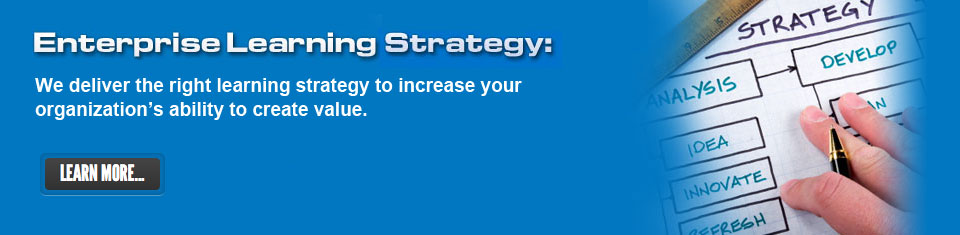
At Dave Basarab Consulting, we're experts in creating Enterprise Learning Plans. We work with you to develop your company's learning strategy and direction.

More...

Custom Design, Development, & Delivery

Custom Design, Development, & Delivery

Custom training is an effective way of developing the capability required to execute your strategy. We are a custom design house that creates programs specific to your business.

More...

Learning Burst Development

Learning Burst Development

We can create and deliver your courses via our unique Learning Burst Method - keeping your employees at their jobs while receiving world-class training.

More...

Predictive Evaluation

Predictive Evaluation

We predict the ROI for your courses and establish success gates. We then evaluate the course against the success gates to show value realized and continually improve results.

More...

Leadership Development

Leadership Development

Turn-key virtual custom leadership development program that combines world-class leadership speakers/educators with post-event personalized coaching to provide you with a cadre of highly skilled leaders.

More...

Predictive Evaluation

Custom Training That Connects Sales Skills With Service

Customer-facing employees shape how buyers understand, trust, and remember a company. Their work may involve prospecting, presenting solutions, answering questions, resolving complaints, renewing accounts, or supporting users after a purchase. Each interaction can influence revenue and loyalty.

Custom training for customer-facing teams must therefore develop two capabilities together: the confidence to create commercial value and the judgment to protect the customer relationship. A sales conversation that ignores customer needs can damage trust, while service that never recognizes buying opportunities can leave value unrealized.

The strongest learning programs reflect the organization’s products, customer segments, systems, brand promise, and performance expectations. They also connect classroom behavior with measurable business outcomes, rather than treating training completion as evidence of success.

Why Balance Matters

Sales skills help employees discover needs, communicate value, manage objections, and move opportunities forward. Service skills help them listen carefully, respond with empathy, solve problems, and maintain confidence when expectations are not met. In practice, these capabilities overlap during nearly every customer interaction.

A representative may need to recommend an upgrade while resolving a complaint, or identify a renewal risk while providing technical assistance. Training should prepare employees for these blended moments instead of separating “selling” and “serving” into disconnected courses. The goal is a consultative approach in which commercial recommendations feel relevant, timely, and useful.

Diagnose Customer Moments

Effective instructional design begins with the customer journey. Map the moments where employees influence acquisition, conversion, onboarding, retention, expansion, and recovery. Then identify the behaviors that make each moment successful, such as asking diagnostic questions, explaining trade-offs, documenting commitments, or escalating issues appropriately.

Stakeholder interviews, call reviews, customer feedback, performance data, and manager observations can reveal where capability gaps actually occur. A team may need product knowledge, but it may also need better conversation structure, decision-making authority, system navigation, or coaching. This diagnosis prevents a generic sales training program from being used to solve an operational problem.

Build One Learning Architecture

A coherent curriculum can combine foundational customer service, consultative selling, communication skills, product application, and leadership support. Short learning bursts can reinforce a key behavior before a customer interaction, while workshops and simulations provide space for practice and feedback.

Dave Basarab Consulting’s learning consultancy approach can help organizations connect custom instructional design with enterprise learning strategy. The design should specify what employees must know, do, and demonstrate, along with how managers will reinforce those behaviors after formal training.

Capability Sales Focus Service Focus Shared Outcome
Discovery Uncover needs and buying motives Understand concerns and context Relevant recommendations
Communication Present value and handle objections Explain clearly and show empathy Greater trust
Problem solving Remove barriers to purchase Resolve issues efficiently Stronger customer confidence
Follow-through Advance the opportunity Keep commitments visible Better retention and loyalty
Measurement Track conversion and revenue Track satisfaction and resolution Clear business impact

Practice The Moments That Matter

Role-play is most useful when it reflects real customer situations rather than scripted ideal conversations. Scenarios might include a price-sensitive prospect, an urgent complaint, a confused new user, or an existing customer considering a competitor. Employees should practice moving between exploration, recommendation, resolution, and follow-up.

Facilitators can use structured observation guides to assess behaviors such as listening quality, question choice, accuracy, tone, compliance, and next-step clarity. Repeated practice helps employees develop adaptable judgment instead of memorizing phrases. Digital simulations, peer coaching, call calibration, and manager-led huddles can extend this practice into the workflow.

Equip Managers To Reinforce Behavior

Frontline managers determine whether learning becomes part of daily performance. They need simple coaching tools, behavior-based observation checklists, conversation prompts, and access to examples of effective customer interactions. Without reinforcement, employees often return to familiar habits when workload or customer pressure increases.

Leadership development should also address how managers balance revenue targets with customer outcomes. Coaching should examine both what was sold and how the interaction affected trust, adoption, satisfaction, and future value. A manager who recognizes these connections can create accountability without encouraging aggressive or unsuitable selling.

Measure Adoption And Business Impact

Training evaluation should distinguish participation from application. Useful indicators may include use of discovery questions, recommendation quality, first-contact resolution, average handling time, conversion, renewal, customer effort, complaints, and customer lifetime value. The right measures depend on the customer journey and the behavior being changed.

Predictive Evaluation can help forecast whether a program is likely to be adopted, create the intended impact, and generate a worthwhile return on investment. Organizations exploring client examples can see how learning initiatives may be connected to practical business priorities. Baseline data, leading indicators, manager observations, and outcome measures should be planned before delivery begins.

Put The Program Into Practice

A focused implementation approach keeps the learning relevant and measurable:

  • Segment scenarios by role, channel, customer type, and level of responsibility.
  • Define observable behaviors for both revenue generation and customer care.
  • Prepare managers to coach the behaviors during real work.
  • Use learning bursts, practice, and job aids to support long-term retention.
  • Review customer and business data regularly, then refine the curriculum.

A pilot with one team or customer segment can reveal whether the content, tools, and measures are practical. Feedback should be gathered from learners, managers, customers, and operational leaders so that refinements address the full performance system rather than only the training experience.

When sales capability and service excellence are designed as complementary skills, customer-facing teams can create value without sacrificing trust. Build a custom program around real customer moments, reinforce it through management, and measure the behaviors and results that matter. Explore the training and evaluation services available through Dave Basarab Consulting to turn customer interactions into stronger relationships and measurable business performance.

Learning to Performance

Learning to Performance, a complete training approach, gives companies world-class training to drive significant return. This approach includes upfront work (Impact Mapping, design), training (for staff and company executives), and post-training efforts to ensure training transfer. This unique recipe - the key for successful training and adoption - is changing the way companies implement training. This methodology could work with any content for organizations in any industry.

More...