


• 1
  • 2
  • 3
  • 4

Dave Basarab Consulting has elevated the training experience, offering an end-to-end comprehensive approach that includes training strategy, instructional design, development, delivery , post program training transfer, and evaluation (via the unique Predictive Evaluation methodology). Virtual Chief Architect Dave Basarab has combined all of these individual training elements with his user-friendly, comprehensive Learning to Performance approach, which significantly increases companies' training ROI.

Why we are different

  • Innovation: Our primary focus is creating learning programs using a Learning to Performance approach.
  • Expertise: Dave offers the depth and breadth of his experience, including working internally at prestigious companies (Motorola, Ingersoll Rand and Pitney Bowes) as well as his knowledge and expertise as a highly-respected, sought-after consultant.
  • Partnership: Basarab collaborates with companies, serving as their own Chief Learning Officer whenever they need to plan, strategize, or implement training initiatives.

Training Services

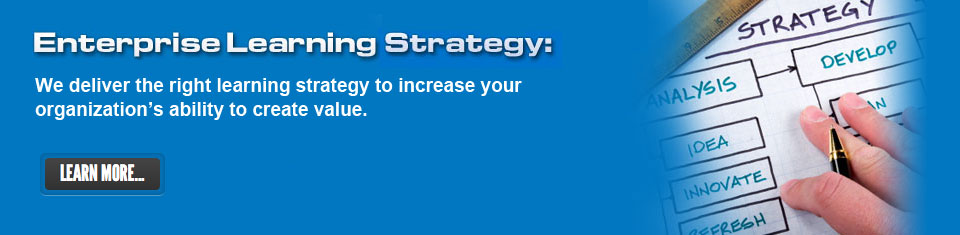
Enterprise Learning Strategy

Enterprise Learning Strategy

At Dave Basarab Consulting, we're experts in creating Enterprise Learning Plans. We work with you to develop your company's learning strategy and direction.

More...

Custom Design, Development, & Delivery

Custom Design, Development, & Delivery

Custom training is an effective way of developing the capability required to execute your strategy. We are a custom design house that creates programs specific to your business.

More...

Learning Burst Development

Learning Burst Development

We can create and deliver your courses via our unique Learning Burst Method - keeping your employees at their jobs while receiving world-class training.

More...

Predictive Evaluation

Predictive Evaluation

We predict the ROI for your courses and establish success gates. We then evaluate the course against the success gates to show value realized and continually improve results.

More...

Leadership Development

Leadership Development

Turn-key virtual custom leadership development program that combines world-class leadership speakers/educators with post-event personalized coaching to provide you with a cadre of highly skilled leaders.

More...

Predictive Evaluation

Designing scenario-based training for customer service excellence

Scenario-based training has become a cornerstone of customer service development. It places learners inside realistic service interactions where they must read the situation, choose a response, and observe the immediate consequence. Australian contact centres and retail floors have adopted this approach because it builds muscle memory that scripts alone cannot create.

Australia presents a distinctive backdrop for customer service work. The country operates under the Australian Consumer Law, which gives customers strong guarantees about product quality and refunds. The workforce spans Sydney headquarters, Perth FIFO operations, regional tourism hubs around the Great Barrier Reef, and multilingual communities in Melbourne's western suburbs. Service staff encounter customers who expect a fair go, use colloquial shorthand such as "no worries" or "how ya going", and sometimes switch between English and another language mid-sentence.

The sections that follow examine how to build branching scenarios, choose between delivery formats, link training decisions to business outcomes, and reinforce learning once the workshop ends.

What scenario-based training actually involves

At its core, scenario-based learning presents a problem in context, asks for a response, and feeds back the result. Good scenarios include a believable customer persona, a clear situation, and a menu of options that includes the obvious wrong turns. A customer complaining about a faulty handset in a Telstra store, a FIFO worker resolving a payroll issue from a Pilbara camp, or a tourist asking about reef tour cancellations each create different decision pressures.

Adults learn through consequences rather than lectures. When a learner chooses an empathetic opening and watches the customer's tone soften, the pattern sticks. When they choose a defensive script and see the complaint escalate, the lesson lands harder than any policy document could deliver. The training becomes a safe rehearsal space, not a test.

Building realistic scenarios for Australian contexts

Scenarios feel authentic when they reflect the daily reality of the learner. For a Brisbane bank contact centre, that might mean walking through a hardship application from a small business owner affected by interest rate movements. For a South Australian energy retailer, it could involve explaining a smart meter reading to a customer with a higher-than-expected bill. For a Gold Coast hotel, it might centre on a guest whose connecting flight was cancelled.

Writers should resist importing American or generic templates. Australian customers refer to "sickies" rather than sick days, ask "can I get a feed?" when hungry, and expect empathy when something goes wrong. Local flavour signals that the scenario is grounded in real practice rather than adapted from an overseas deck.

Structuring the branching decision tree

The decision tree is the engine of any scenario. Each learner choice triggers a new branch, which may lead to a successful resolution, a partial fix, or a full breakdown that requires restarting the call. Designers typically begin with the optimal path, then construct two or three detours that reveal common mistakes, such as failing to acknowledge the customer's feelings or promising a refund that the policy does not allow.

Decision trees also need scoring logic. Did the learner gather the right information before offering a solution? Did they protect the customer's rights under the Consumer Law? Did they recognise when to escalate? A well-built tree can host twelve to twenty meaningful decisions without overwhelming the participant.

Comparing delivery formats

Choosing how learners experience the scenarios shapes both cost and impact.

Format Best use case Strength Limitation
Live role-play with a facilitator Soft-skills workshops, leadership cohorts High emotional realism, immediate coaching Time-intensive, inconsistent across facilitators
Branching e-learning module Large distributed workforces, compliance refreshers Scalable, consistent, tracks every decision Can feel sterile, limited emotional depth
Video-led scenarios with decision points Mid-sized teams needing flexibility Balances realism and scale, easy to update Higher production cost than text-based modules
Immersive VR simulation High-stakes or rare-event training Total immersion, powerful for empathy work Significant investment in hardware and content
Hybrid: live kickoff plus digital scenarios Sustained learning programs Combines social learning with on-demand practice Requires careful integration and curation

Most Australian programs blend two of these formats. The mix depends on whether the workforce sits in a single city or is spread across regional offices and remote sites.

Connecting scenarios to business outcomes

Training budgets in Australia face scrutiny after high-profile customer service failures in banking and telecommunications. Linking scenario design to measurable outcomes protects the program from being cut. Designers should start with the business question: are we trying to reduce average handle time, lift first-contact resolution, decrease regulatory complaints, or improve frontline retention?

Each scenario can then be mapped to a specific behavioural shift. A complaint-resolution scenario might target empathy and policy accuracy, both observable in quality audits. Once the mapping is clear, organisations can track whether new behaviours stick across cohorts. The challenge of comparing results across multiple groups with different starting points is well documented in any serious analysis of training ROI across cohorts. Without that discipline, scenario training becomes an expensive theatrical exercise rather than a business tool.

Predictive evaluation for scenario programs

Predictive Evaluation offers a way to forecast adoption, impact, and financial return before the program rolls out at scale. The methodology tests scenarios with a small sample of frontline staff, measures the behaviour change against a control group, and projects likely outcomes for the wider population. For an Australian organisation rolling out new complaint handling procedures, this approach reveals whether a scenario will change behaviour or simply entertain participants.

The predictive step also flags design weaknesses. If testers consistently choose the wrong option at a critical decision point, the wording probably needs revision. If testers finish too quickly, the scenario may be too linear. Early detection saves the cost of rebuilding the program after launch.

Sustaining skills beyond the workshop

A single workshop rarely changes long-term behaviour. Skills decay quickly when frontline staff return to busy queues. The most effective programs pair the initial scenario experience with shorter, targeted refreshers that arrive in the weeks after the workshop. These refreshers work best when they arrive in the flow of work, not in a separate training calendar.

Short, focused refreshers can extend the life of scenario learning far beyond the classroom. The role of these learning bursts in change management is to anchor new habits through repetition and variation, rather than relying on a single intense training day. A well-timed burst might present a new variation of a familiar scenario and ask the learner how they would handle it.

Practical guidelines for implementation

  • Start with one high-volume, high-stakes customer interaction and build a single scenario around it before scaling up.
  • Use real call recordings, with appropriate consent, as source material for authentic dialogue.
  • Include at least one decision point that tests compliance with the Australian Consumer Law.
  • Map every scenario to a specific behavioural metric that already appears in operational reporting.
  • Pilot with a representative cross-section of sites, including regional and metropolitan locations.
  • Build in spaced refreshers rather than relying on the initial workshop to do all the work.
  • Capture learner choices at decision points so that program owners can identify common mistakes.

The next practical step is to record two recent difficult customer calls from your contact centre, strip out identifying details, and draft a branching scenario around the most teachable moment in each call, then pilot them with a small cohort of frontline staff within the next fortnight.

Learning to Performance

Learning to Performance, a complete training approach, gives companies world-class training to drive significant return. This approach includes upfront work (Impact Mapping, design), training (for staff and company executives), and post-training efforts to ensure training transfer. This unique recipe - the key for successful training and adoption - is changing the way companies implement training. This methodology could work with any content for organizations in any industry.

More...