


› ‹
  • 1
  • 2
  • 3
  • 4

Dave Basarab Consulting has elevated the training experience, offering an end-to-end comprehensive approach that includes training strategy, instructional design, development, delivery , post program training transfer, and evaluation (via the unique Predictive Evaluation methodology). Virtual Chief Architect Dave Basarab has combined all of these individual training elements with his user-friendly, comprehensive Learning to Performance approach, which significantly increases companies' training ROI.

Why we are different

  • Innovation: Our primary focus is creating learning programs using a Learning to Performance approach.
  • Expertise: Dave offers the depth and breadth of his experience, including working internally at prestigious companies (Motorola, Ingersoll Rand and Pitney Bowes) as well as his knowledge and expertise as a highly-respected, sought-after consultant.
  • Partnership: Basarab collaborates with companies, serving as their own Chief Learning Officer whenever they need to plan, strategize, or implement training initiatives.

Training Services

Enterprise Learning Strategy

Enterprise Learning Strategy

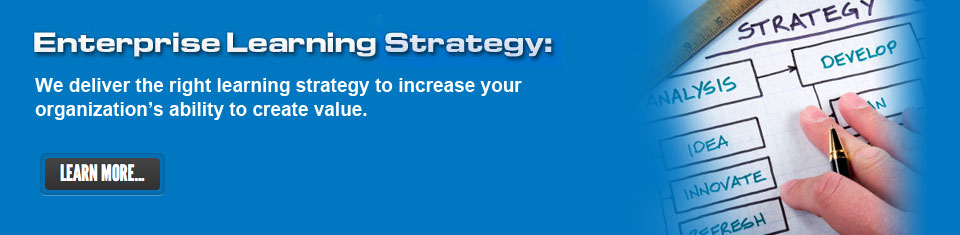
At Dave Basarab Consulting, we're experts in creating Enterprise Learning Plans. We work with you to develop your company's learning strategy and direction.

More...

Custom Design, Development, & Delivery

Custom Design, Development, & Delivery

Custom training is an effective way of developing the capability required to execute your strategy. We are a custom design house that creates programs specific to your business.

More...

Learning Burst Development

Learning Burst Development

We can create and deliver your courses via our unique Learning Burst Method - keeping your employees at their jobs while receiving world-class training.

More...

Predictive Evaluation

Predictive Evaluation

We predict the ROI for your courses and establish success gates. We then evaluate the course against the success gates to show value realized and continually improve results.

More...

Leadership Development

Leadership Development

Turn-key virtual custom leadership development program that combines world-class leadership speakers/educators with post-event personalized coaching to provide you with a cadre of highly skilled leaders.

More...

Predictive Evaluation

Training design for a more agile workforce

Designing training that supports agility in a rapidly changing business environment requires a different starting point from a catalogue of courses. Leaders need a repeatable way to turn shifting priorities into observable workplace behaviour, while employees need opportunities to practise before performance pressure arrives.

This approach connects enterprise learning strategy with custom instructional design, leadership development, learning bursts and targeted training delivery. The goal is not simply faster content production; it is a closed learning cycle in which evidence of adoption, impact and return informs the next design decision.

Frame learning around business movement

Agility begins with identifying what can change: customer expectations, regulation, technology, supply constraints or operating priorities. In Australia, that often means helping distributed teams in Sydney, Melbourne and Brisbane respond to hybrid work, skills shortages and fast-moving client needs.

A useful brief names the business shift, the performance gap, the people affected and the evidence required. Rather than promising broad “agile thinking”, define actions such as leading a dispersed team through reprioritisation, testing a new service or making a safer decision at the point of work.

A practical evaluation walkthrough shows how L&D leaders can connect forecast measures with learning design before delivery. That early discipline reduces the temptation to launch a generic program for a problem that needs a specific rehearsal, tool or coaching intervention.

Build scenarios around real work

Scenarios are credible when they reflect the operating context, not merely the training topic. For an ASX-listed organisation, for example, a scenario might involve revising a forecast during a volatile quarter; for a resources business, it could cover a shift handover or a decision on a remote site.

Australian workplace customs also matter. Participants may value direct, practical discussion, peer learning and concise materials, while managers need modules that work across metro, regional and fully remote teams. Mandatory topics such as work health and safety, privacy and anti-discrimination should remain embedded in relevant scenarios rather than treated as optional extras.

Customisation also accounts for how people learn and work. Employee feedback loops can test whether examples, difficulty and terminology match the audience. A short pulse after the first practice cycle can expose confusing instructions before larger cohorts encounter them.

Create a design system for rapid iteration

Rapid response does not mean skipping learning design. It means modularising the architecture so scenarios, exercises, job aids and assessments can change without rebuilding everything. Learning bursts can release one capability at a time and create evidence about what employees are ready to try.

The build checklist should stay deliberately small:

  • Name the business decision or behaviour that must change.
  • Write realistic constraints, including time, systems and competing priorities.
  • Build one short practice cycle with observable success criteria.
  • Include role-specific job aids and examples from the target workplace.
  • Pilot with a small, cross-functional group before wider release.

A second checklist focuses on application rather than production:

  • Make practice available within 48 hours of the learning.
  • Give managers a specific reinforcement prompt for team discussions.
  • Capture one observable signal of use, quality or speed.
  • Review application after two weeks and adapt from evidence.
  • Recognise applied learning and useful fixes, not attendance alone.

These checks protect speed without creating noise. A polished facilitator deck may satisfy a delivery schedule, but a tested scenario is more likely to transfer into daily work.

Measure adoption before claiming impact

Attendance indicates reach, not behavioural change. The design team should forecast who will use the learning, what they will do differently and which result may move. The adoption and evaluation measures behind Predictive Evaluation can make those assumptions explicit and give leaders a shared baseline.

Combine quantitative and qualitative evidence: completion, tool use, manager observations, customer outcomes and employee confidence. Return on investment should be treated as an estimate with stated assumptions, then revised as evidence emerges, rather than a guaranteed saving.

Feedback is most valuable when it becomes a design input. Review a small cohort after its first application cycle, compare intention with actual action, and adjust the next scenario. This makes evaluation predictive as well as retrospective and supports continuous improvement across the learning portfolio.

Compare formats by purpose and reach

No delivery format is inherently agile. Blended learning can combine self-paced foundations with facilitated practice, while live workshops suit complex conversations and immediate feedback. The decision should follow the behaviour, audience size, technology access and time available.

The formats can be compared as follows:

Approach Best suited to Speed to deploy Main design risk
Learning burst One narrow skill or timely refresh High Treating a brief intervention as a full capability build
Live workshop Complex discussion, coaching and group problem-solving Medium Inconsistent transfer when practice ends with the event
Microlearning Reinforcement, procedures and just-in-time prompts High Fragmentation without a coherent practice sequence
Blended program Multi-step behaviour change across roles Medium to low Overloaded pathways and unclear ownership between modes

For regional and shift-based teams, downloadable mobile content and protected practice time often matter more than feature-rich platforms. Sydney and Melbourne teams may support richer live sessions, but the same scenario and measurement standards should apply everywhere.

Turn strategy into a focused next cycle

An agile learning capability is visible in its operating rhythm, not in a shelf full of programs. Bring business owners, facilitators and people managers into one short review of current assumptions, adoption evidence and urgent skill gaps. Choose one gap where a new scenario can be tested within the next month.

The immediate next step is to schedule a 60-minute cross-functional design review and leave it with one pilot scenario, named business outcome, adoption measure and decision date.

Learning to Performance

Learning to Performance, a complete training approach, gives companies world-class training to drive significant return. This approach includes upfront work (Impact Mapping, design), training (for staff and company executives), and post-training efforts to ensure training transfer. This unique recipe - the key for successful training and adoption - is changing the way companies implement training. This methodology could work with any content for organizations in any industry.

More...