


Category: Training and Development
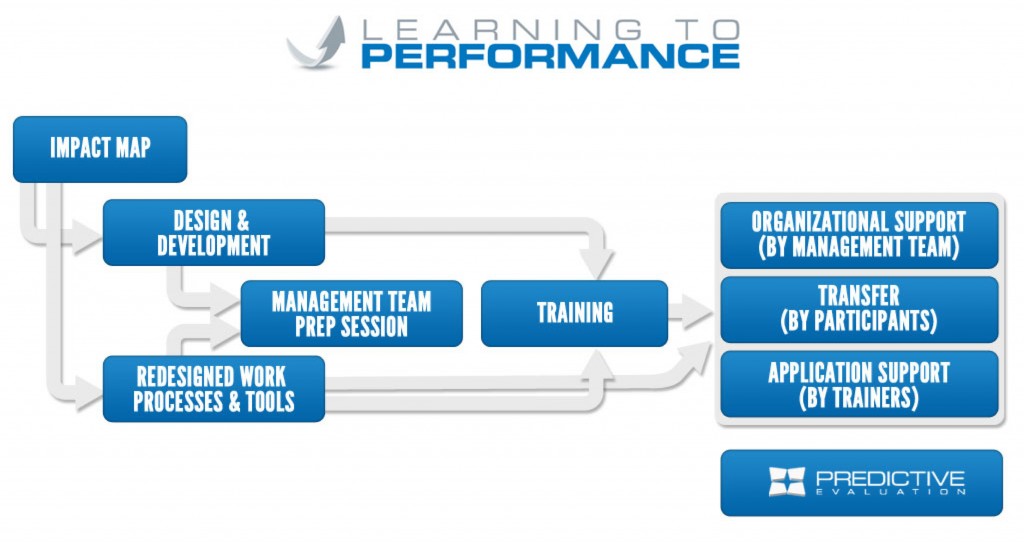
The third step in the Learning to Performance System is to begin instructional design and course development . The output of the second step, the Impact Map , is considered for this activity. The purpose of this task is to take the first column of the map and seamlessly turn it into training .
I use the ADDIE model for my design and development efforts . The ADDIE Model is a generic term for the five-phase instructional design model consisting of Analysis, Design, Development, Implementation, and Evaluation. Each step has an outcome that feeds into the next step in the sequence.
Often, companies diagnose a performance gap, requiring training as the solution. Isolated training events that don’t take a “complete training approach” produce less results (value to the business) than a more comprehensive, integrated approach. Complete training combines learning, leadership and change management competencies to produce documented, sustainable results and value. With all my custom training solutions , I use this approach, which I call the Learning to Performance System :
The Steering Committee has accomplished a good deal to get to this point. To recap, you have the following predictive elements in place: Beliefs, Intention Goals, Adoptive Behaviors, Distribution of Goals, Adoption Rate, Adoption Value, and External Contribution Factors.
These are all the elements needed to calculate annual impact per participant using the Impact Matrix. The Matrix uses simple formulas to calculate training’s predicted impact.

Chief Learning Officer Newsletter published an article on my Learning Burst approach in their March 14, 2012 issue titled Short is Sweet in Learning . In it I discuss the concept of learning bursts and the benefits of the approach. The writer uses the term microlearning which is a nice way of describing the approach. I especially like the way he wove in analogy to a box of chocolates.
Case studies are descriptions of a real life experience, related to the content in Learning Burst training , which are used to make points, raise issues or otherwise enhance the participants’ understanding and learning experience. The account usually follows a realistic scenario, such as a management or technical problem, from start to finish. Because they provide practical examples of problems and solutions, challenges and strategies, they support more theoretical material and often make the “lesson” more memorable and believable for the class.

Simulations in Learning Burst training are simplified versions of reality; they place participants in realistic business environments where they are asked to complete tasks with legitimate business goals. They capture the essentials of a workplace environment in a way that allows participants to apply new skills, try different approaches and explore the implications of decisions and actions risk free.
Last week I shared the first two steps to create training using the Learning Burst method. Here are the next two steps.
 Step 3: Develop the design document for a Learning Burst course.
The instructional design document provides detailed instructions on how to build the Learning Burst course, but it doesn’t contain any actual course content; it’s similar to an architect’s blueprint or a software engineer’s design document. The instructional design document will perform the following tasks:
Step 3: Develop the design document for a Learning Burst course.
The instructional design document provides detailed instructions on how to build the Learning Burst course, but it doesn’t contain any actual course content; it’s similar to an architect’s blueprint or a software engineer’s design document. The instructional design document will perform the following tasks:
Over the past few weeks I have been posting about the Learning Burst method. In today’s post I share the first 2 steps I use to create Learning Bursts. Additional steps to follow in the next few weeks.
 Step1: Determine if content is appropriate for a Learning Burst.
Consider what skills you are training, and how you want your employees to use those skills in their jobs. Answer the questions below and decide if you have a candidate for Learning Bursts.
Step1: Determine if content is appropriate for a Learning Burst.
Consider what skills you are training, and how you want your employees to use those skills in their jobs. Answer the questions below and decide if you have a candidate for Learning Bursts.
- How many employees need to be trained? How quickly? Learning Burst work well with larger number of employees so that he savings are realized. However, I have done sessions with 5-10 people and it works well.
- What is the geographic distribution of the participants? Learning Bursts work well when the participants are spread over many geographic areas.
- Can Learning Bursts be used in conjunction with the face-to-face training you currently use? This method works very well to provide participants with foundational knowledge of concepts – this reduces face-to-face time or allows more time for application practice.
- Is the culture ready to make Learning Bursts a success? If your culture already is or is ready to use alternate forms of training then Learning Bursts have a chance of success. If not, you may not want to use Learning Bursts.
- Can the content be broken in small independent pieces? Each Learning Burst has a target length of 20 minutes (listening to the audio and completing the workbook). This lends itself to each burst being a single topic or concept. If your training content can be broken down into small, single topic segments, then it is a good Learning Burst course.
The Learning Burst method goes beyond standard training expectations and provides something “more” while adding little or nothing to its cost. Learning Bursts deliver a teaching approach that is practical, simple, and to the point instead of the more traditional courses delivered either in classrooms or online. It is a teaching vehicle that is tailored to the changing work styles and learning behavior of today’s employees in a cost-effective, individually customized, and company-focused manner.
So what are some of the ways that companies are using Learning Bursts?
In today’s world in the midst of a recession companies have trimmed their labor forces while keeping or expanding the same level of service and product offerings. This places stress on an already task saturated workforce who simply cannot afford time away from the job for training. Couple that with new skills and capabilities needed to meet market demands along with reduced training budgets and the need for a different and cost effective way to deliver training has risen.
Learning Bursts puts the needs of the participant first. While employees can no longer afford days away from the job for training I uncovered through years interviewing students that they could find 20 minutes a day to learn something new related to their job. And they need it on their schedule not that of the training department. Next, they want these “bursts” of training to be independent of each other – meaning they want the nugget of learning that they need without having to wade through dozens of learning experiences. Finally as I walked around and met with these employees, I noticed on numerous occasions that they had hundreds of screen captures printed from e-learning courses. I came to realize that even in this digital age, they want and use paper!