



How to Evaluate Training using the Predictive Evaluation Model

 At last, an answer to the question that had bedeviled trainers for decades:
how do you make the business case for training?
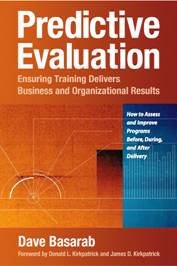
Dave Basarab’s book
Predictive Evaluation
enables you to effectively and accurately forecast training’s value to your company, measure against these predictions, establish indicators to track your progress (and make mid-course corrections if needed) and report the results in a language that business executives respond to and understand. It’s an approach that can be used for any sort of training program, in any setting, whether planned, newly implemented, or long-established.
At last, an answer to the question that had bedeviled trainers for decades:
how do you make the business case for training?
Dave Basarab’s book
Predictive Evaluation
enables you to effectively and accurately forecast training’s value to your company, measure against these predictions, establish indicators to track your progress (and make mid-course corrections if needed) and report the results in a language that business executives respond to and understand. It’s an approach that can be used for any sort of training program, in any setting, whether planned, newly implemented, or long-established.
Predictive Evaluation
- Outlines a definitive process for determining the effectiveness and business impact of training.
- Works with any training program in any setting and at any stage of development.
- Contains a how-to guide filled with worksheets, examples and other tools.
In Predictive Evaluation, Dave Basarab explains how to begin by zeroing in on the program’s intentions: what specific goals and beliefs do you want to instill in participants? The next step is to determine what these will look like when put into action—what precise on-the-job actions and behaviors do you expect to see if these goals and beliefs are adopted? Finally you develop quantifiable measures of how employees’ adopting the target beliefs and goals will impact the business. In the end all of the information is pulled together into an Impact Matrix that provides a definitive picture of the program’s intended and actual bottom-line results.
A key strength of predictive evaluation is that it is profoundly collaborative. Supervisors and employees work together to establish standards for success each step of the way. This guarantees the results will be relevant to the business and gives all participants a sense of ownership in the process.
Predictive evaluation will greatly enhance the acceptance of training as a business function, one where projections are made, progress measured, and effectiveness definitely determined. Rather than being regarded as an expense and an act of faith, training will be seen as an investment with a concrete payoff.